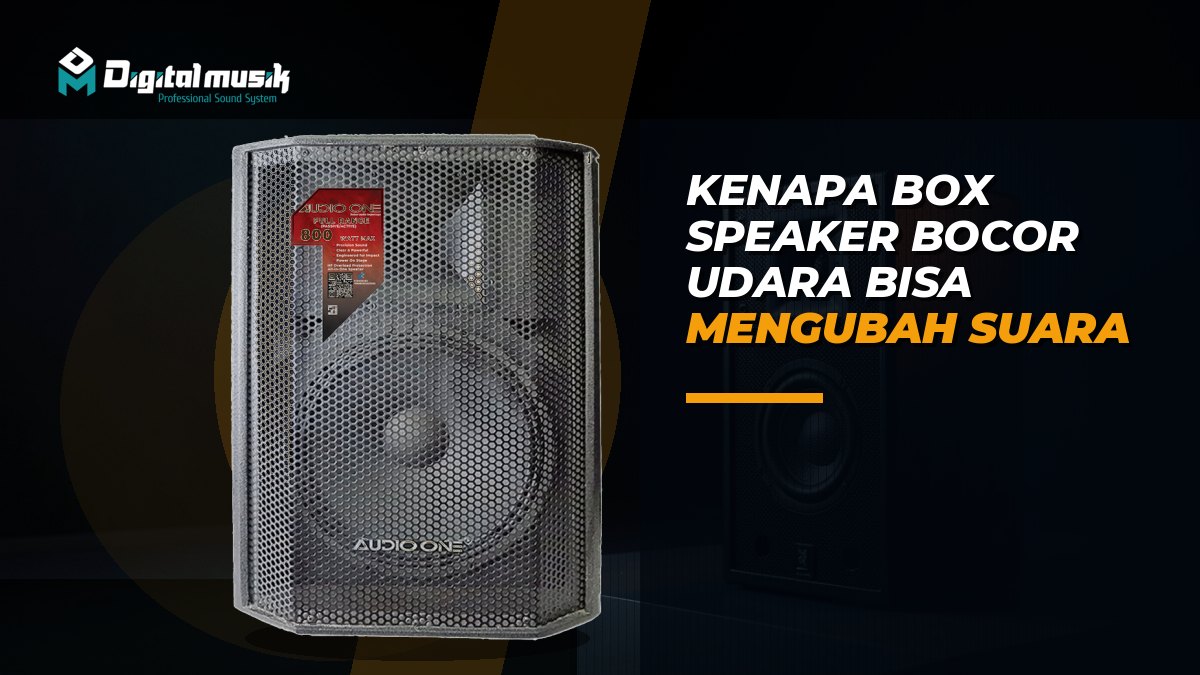
Have you ever felt your speaker's bass sound thin, lacking depth, or even producing a strange hum after being moved or experiencing an impact? Often, the main cause is not the amplifier or driver, but the structural integrity of the cabinet or speaker box itself. When a speaker box leaks air, the acoustic properties of the enclosure change drastically, transforming the speaker from a controlled system into an inefficient system that can potentially damage components.
Why Air Leaks Turn into Sound Problems
To understand the impact, we need to look at how a speaker works. A speaker driver moves back and forth, pushing air forward (sound) and backward. In a passive speaker, the space behind this driver is called the enclosure or box. The air inside this box is compressed and acts as a spring that helps control the movement of the speaker's cone.
If the box leaks, the air pressure behind the driver cannot be maintained stably. As a result, control over the driver's movement becomes weak. This produces several negative audible effects:
- Reduced Bass Response: Bass energy that should be directed outwards is instead wasted through the leaky gaps. The bass sounds shallow and less 'punchy'.
- Increased Distortion: Because the driver's movement is uncontrolled, the sound becomes broken or vibrates (chuffing), especially at high volumes.
- Unnatural Resonance: Air entering and exiting small gaps can create a humming or hissing sound that does not originate from the driver.
How to Diagnose Air Leaks in a Cabinet
Before deciding to repair or replace, perform the following simple checks to ensure whether the box is actually leaking:
- Visual Inspection: Check all panel joints, corners, and areas around the port holes (if any). Look for gaps, cracks, or peeling glue.
- Vibration Test: Turn on the speaker with strong bass music. Place your palm on various parts of the cabinet panels. If you feel uneven vibrations or certain panels feel 'light' and vibrate more intensely, it indicates that the panel is not rigidly attached.
- Air Blow Test: Turn off the speaker. Use your breath to blow air towards the suspected gaps. If you feel a significant pull or airflow, it means there is a leak.
Long-Term Impact on the Driver
Allowing a box to leak for a long time can have impacts beyond just sound quality. Speaker drivers are designed to work with a specific mechanical load (Qts). When the box leaks, this load changes, causing the driver to operate outside its optimal limits. This can lead to:
- Overheating of the voice coil.
- Damage to the spider suspension and surround.
- Significant reduction in driver lifespan.
Solutions and Prevention
If a leak is found, the solution depends on the severity:
- Small Leaks: Can be repaired with high-quality wood glue, special speaker sealant, or acoustic insulation tape. Ensure the area is properly coated and completely dried before use.
- Structural Leaks: If panels are cracked or joints are severely loose, repair may not be sufficient. In this case, the cabinet construction needs to be rebuilt or replaced.
For prevention, ensure that every joint on the speaker cabinet uses sufficient glue and is reinforced with nails or screws. Use sealant on corners to ensure airtightness. If you use speakers for touring or outdoor events, consider using a flight case or hardcase designed to protect the cabinet's integrity from impacts and environmental changes.
When to Consult a Professional?
If you are an audio operator or professional system owner, and this issue occurs in mass-produced or custom units, it could indicate a problem in the manufacturing process or materials. If you are planning custom speaker cabinet production or require technical evaluation to ensure the rigidity and acoustics of the enclosure meet standards, PT Digital Musik Indonesia can be a discussion partner. We can assist with material specification consultation, cabinet structure design, and fabrication processes to ensure the final product has optimal acoustic integrity.
To understand more about how speaker sensitivity affects overall performance, you can read our article on Sensitivity Speaker 95 dB vs 100 dB. Additionally, if sound issues are also related to system setup, the guide Cara Menyamakan Level Speaker Kiri dan Kanan can help ensure system balance.
FAQ
Do all speaker boxes need to be airtight?
Not all. Bass-reflex (ported) speakers have port holes intentionally created to allow air to flow. However, apart from these port holes, all other parts of the cabinet must be airtight. Leaks outside the port will still degrade performance.
How long does it take for the effects of an air leak to become noticeable?
The effects can be felt immediately when the speaker is turned on, especially at low frequencies. However, damage to the driver due to long-term leaks only becomes apparent after repeated use over a certain period.