Why Does Bass Sound Strong Near Speakers But Disappear at a Certain Distance?
You might have experienced this situation: when standing right in front of a speaker or subwoofer, the bass thump feels so powerful and full. However, when you step back a few meters, that bass sensation seems to disappear, become faint, or even almost inaudible. This phenomenon is quite common, especially indoors or in open areas. There are several main reasons behind the loss of bass 'kick' as the distance from the sound source increases.
Understanding the causes is the first step to finding solutions. This article will thoroughly explore why bass can sound different at varying distances, and provide practical guidance on how to address it.
Common Causes of Bass Loss with Distance
This phenomenon is closely related to how bass sound waves interact with the environment, as well as the physical limitations of the speaker itself.
1. Sound Wave Propagation
Bass sound waves have very long wavelengths. As these waves move away from the speaker, they don't just travel straight forward. Bass waves tend to bend and spread in all directions. Near the speaker, you capture the wave energy directly. However, the further you move, the more that energy is dispersed over a wider area, drastically reducing its intensity per square meter.
2. Wave Interference
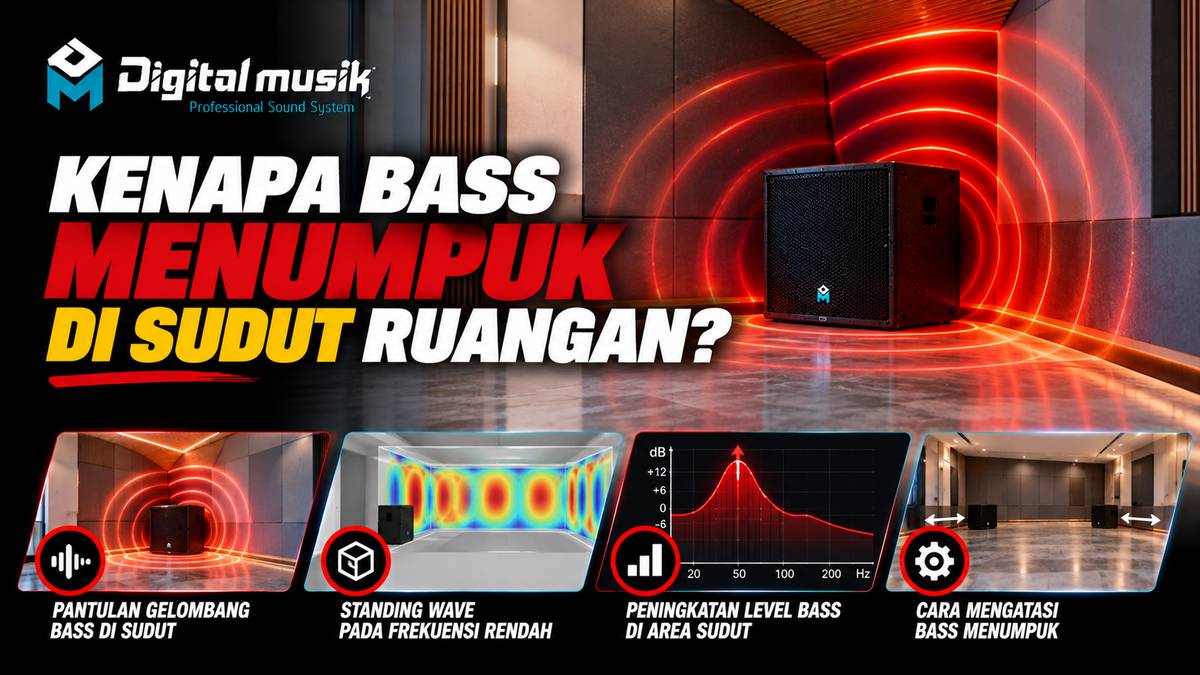
Indoors, bass sound waves will reflect off walls, ceilings, and floors. These reflections then meet the original waves coming from the speaker. This meeting of waves can either reinforce each other (constructive) or cancel each other out (destructive). At some points in a room, reflected waves and original waves can cancel each other out at certain bass frequencies, creating what are called 'nulls' or bass dead spots. These spots often appear at certain distances from the speaker.
3. Speaker Dispersion Pattern
Not all speakers are designed to disperse sound evenly across all frequencies. Bass speakers, especially subwoofers, often have a narrower dispersion pattern at higher frequencies but can spread wider at lower frequencies. However, even with wide dispersion, bass energy will still decrease with distance. Furthermore, if you are using full-range or satellite speakers not supported by a subwoofer, their ability to reproduce deep and powerful bass frequencies evenly throughout the listening area will be very limited.
4. Room Acoustics and Room Size
The size and shape of the room play a crucial role. In small rooms, wave reflections will occur more quickly, and interactions between waves will be more intense. This can exacerbate null bass issues. Conversely, in very large rooms or open areas, the lack of reflections means bass energy relies solely on direct propagation, which inherently decreases with distance.
5. Suboptimal Speaker Placement
The position of speakers in a room greatly affects how sound waves interact with walls and other objects. Placing speakers too close to walls, especially rear walls or corners, can reinforce resonance at certain bass frequencies, but can also create more complex interference problems.
Solutions to Overcome Bass Loss with Distance
Although bass loss with distance is a physical phenomenon, there are several strategies you can implement to minimize this problem and achieve a more consistent bass listening experience:
1. Proper Subwoofer Placement
Experiment with your subwoofer placement. Try placing it in a corner of the room, in the middle of a wall, or in another location. Sometimes, placing the subwoofer in a different position can change the sound wave interaction pattern and improve bass distribution. The 'subwoofer crawl' technique can be very helpful: place the subwoofer in your listening position, play music with strong bass, then crawl around the room. Wherever the bass sounds best while you're crawling, that's the best position to place your subwoofer (then you return to the crawling position and place the subwoofer there).
2. Use More Than One Subwoofer
Using two or more strategically placed subwoofers can significantly flatten the bass response throughout the room. With two subwoofers, you can reduce the effects of nulls and extreme frequency peaks. Common placements are in two opposite corners or in the middle of the front and back walls.
3. Correct Gain and Crossover Settings
Ensure the gain on your subwoofer amplifier or receiver is set correctly. Gain that is too low will result in weak bass, while gain that is too high can cause distortion. Additionally, set the crossover frequency appropriately. The crossover frequency determines the point at which the main speakers stop producing bass and the subwoofer takes over. Proper settings ensure a smooth transition and prevent overlap or frequency gaps.
4. Consider Room Acoustics
For best results, room acoustic treatment can be very helpful. The use of sound absorption materials like thick carpets, curtains, or acoustic panels can help reduce excessive sound wave reflections, thereby mitigating destructive interference problems.
5. Choose Speakers with Appropriate Dispersion
If you are building or renovating an audio system, consider speakers designed for wider dispersion or use subwoofers specifically designed to provide more even bass coverage.
6. Use Speakers with Appropriate Power
Ensure your speakers and amplifier have adequate power for the room size and desired listening distance. 'Underpowered' speakers will struggle to produce strong and consistent bass, especially in more distant areas.
When to Consult a Professional?
If you have tried various placements and settings but the problem of disappearing bass persists, it might be time to consult an audio professional. Complex audio systems, rooms with challenging acoustics, or the need for even sound distribution over a large area often require more in-depth analysis and solutions.
PT Digital Musik Indonesia has experience in the professional audio ecosystem. We can assist you in discussing your audio system needs, from speaker selection, placement, to custom solutions to ensure optimal sound quality throughout the listening area. If you are planning a new audio installation, renovating an existing system, or facing specific challenges such as uneven bass distribution, we are ready to be your discussion partner.
To begin discussing professional audio solutions tailored to your needs, do not hesitate to contact us. We can help map out your requirements and provide appropriate recommendations.
Contact us now for a free consultation and find the best audio solution for you.